CASE STUDY · TECHNOLOGY AND MARKET
How a Brazilian technology is solving the credit crisis in the medical equipment sector
A proprietary solution, developed in Brazil, raised payment compliance from 55% to 93% in laser hair-removal equipment rental — and opened access for thousands of entrepreneurs left out of traditional credit.
Brazil is going through a silent crisis that rarely makes economic headlines, but affects millions of small and medium-sized entrepreneurs every day: the collapse of commercial credit for businesses that cannot offer traditional collateral. According to Serasa Experian data, the country closed 2025 with more than 74 million individuals with negative credit registrations and a record number of business tax IDs (CNPJs) with credit restrictions. In this scenario, a dental surgeon who wants to expand her clinic, an esthetician who wants to grow her services, or an entrepreneur who wants to open a new aesthetic business simply cannot access the equipment she needs.
Banks require real collateral that most do not have. Suppliers demand guarantors or security checks that fall outside the budget. Financing companies offer rates that make return on investment unfeasible. The result is an enormous market of qualified professionals ready to work, but left out — while equipment manufacturers and distributors watch inventories sit idle and growth stagnate.
It was against this backdrop that, throughout 2025, I developed a proprietary technology that attacks the problem at its root. Not from the credit side — which has been tried exhaustively by the traditional financial system — but from the technical-control side of the equipment. The solution, implemented by oLaserTech in its line of laser hair-removal machines starting in the last quarter of 2025, has completely transformed the company's commercial metrics and is being replicated in other contexts of the sector.
Results observed on oLaserTech OL-700 model equipment after the technology was deployed in the last quarter of 2025 (baseline: first 6 months of operation under the new system).
1. The problem: an enormous market outside of credit
Before describing the solution, it is worth detailing the problem Brazil faces. The medical and aesthetic equipment sector moves billions of Brazilian reais every year, but operates under a structural limitation: the equipment consists of high-unit-value goods (a professional laser hair-removal machine costs between R$ 70,000 and R$ 150,000 — roughly US$ 14,000 to US$ 30,000), and most potential buyers — small clinics, self-employed professionals, entrepreneurs just starting out — cannot pay in cash or offer sufficient bank collateral for traditional financing.
What happens in practice? The manufacturer or distributor has three options, and none of them is good. First: sell only to those who pay in cash, which reduces the addressable market to a small fraction. Second: sell in installments without collateral, taking on full default risk — historically resulting in delinquency rates between 30% and 50%, which makes operations unviable. Third: outsource credit to banks or financing companies, which shifts the problem elsewhere and also makes the equipment more expensive for the end customer.
In research I conducted with ten aesthetic equipment distributors in Brazil's Southeast and Central-West regions during the first half of 2025, I identified a consistent pattern: on average, 45% of commercially viable proposals — proposals in which the customer had proven professional qualifications, an operating location and clear demand — were rejected because the customer could not provide the collateral required. Translated into concrete numbers: for every 100 professionals who wanted to operate with quality equipment, 45 gave up or resorted to worse alternatives (used equipment of dubious origin, informal imports, hourly rental in third-party clinics).
The loss is threefold. The entrepreneur does not work, or works with inadequate equipment. The manufacturer does not sell. The end consumer — the person receiving the procedure — is often served in suboptimal conditions. It is a market problem that the right technology can solve.
"Brazil doesn't have a demand crisis for medical equipment. It has a collateral crisis. Whoever solves that won't just sell more — they'll unlock an entire market." — André Roriz, interview for the oLaserTech sector bulletin, October 2025
2. The insight: what if the equipment itself is the collateral?
The question that guided the development of the solution was simple: what if the equipment itself — the very asset being rented or sold on payment terms — functioned as an automatic collateral mechanism? What if, instead of demanding guarantors and security checks, the manufacturer could simply condition the daily operation of the device on payment being current, without depending on banking bureaucracy, without judicial repossession processes, without operating costs?
The question seems obvious in hindsight, but solving it in practice required simultaneously tackling five technical and commercial challenges:
- The equipment must continue to function in clinics without stable internet. A large share of the target customers operate in neighborhoods with poor connectivity, or in interior cities where the network simply goes down several times a day. A solution requiring online communication between equipment and factory would be unusable for exactly the public that needs it most.
- The mechanism must be technically robust against tampering attempts. A customer who buys or rents the equipment has months or years to try to circumvent the system. Any trivial algorithm — fixed codes, simple passwords, local calendar — would be broken quickly, eroding the entire foundation of the model.
- Daily operation must be simple for the customer. It cannot involve installing apps, configuring servers, or doing complex synchronizations. It must work in any clinic, with any technical team — including those less familiar with technology.
- The solution must respect consumer rights and be legally sustainable. If the mechanism is interpreted as abusive, if it locks unduly, or if it causes harm in legitimate maintenance situations, the legal problem will devour any commercial gain.
- It must be scalable on the manufacturer's side, with marginal costs close to zero per unit. If each machine required dedicated infrastructure, expensive hardware, or manual processes, the model would not survive the first hundred devices in the field.
The solution I developed, and which began to be deployed on oLaserTech OL-700 equipment in the fourth quarter of 2025, addresses these five challenges in a unified architecture.
3. The technology: 256-bit cryptography with public and private keys
The core of the solution is a daily unlock-code system based on strong 256-bit cryptography, using a shared-secret architecture between the oLaserTech server and the embedded firmware of the equipment. To operate the device on any given day, the customer must obtain a unique 8-character alphanumeric code — generated exclusively by the oLaserTech portal — and type it into the device panel.
The daily code is mathematically unique for each piece of equipment (bound to its serial number) and for each date. A code generated today for one machine does not work tomorrow. A code generated for customer A's equipment does not work on customer B's equipment. And — perhaps most importantly — the equipment can validate the code entirely offline, without any internet connection, because it carries in its firmware the same cryptographic algorithm the oLaserTech server uses to generate the code.
Without going into technical details beyond the scope of this article, what matters to understand is the practical consequence of this architecture: the oLaserTech server has total control over who receives codes, but the equipment has total autonomy to validate them. This means that, from a commercial standpoint, the key is in the portal. And the key to the portal is being current on payments.
If the customer is current, the portal issues a code. If the customer is behind, the portal simply stops issuing them. The next day, the equipment does not turn on. Pay, or no machine.
The figure below visually illustrates how the system operates, from upfront payment to the daily unlock of the equipment.
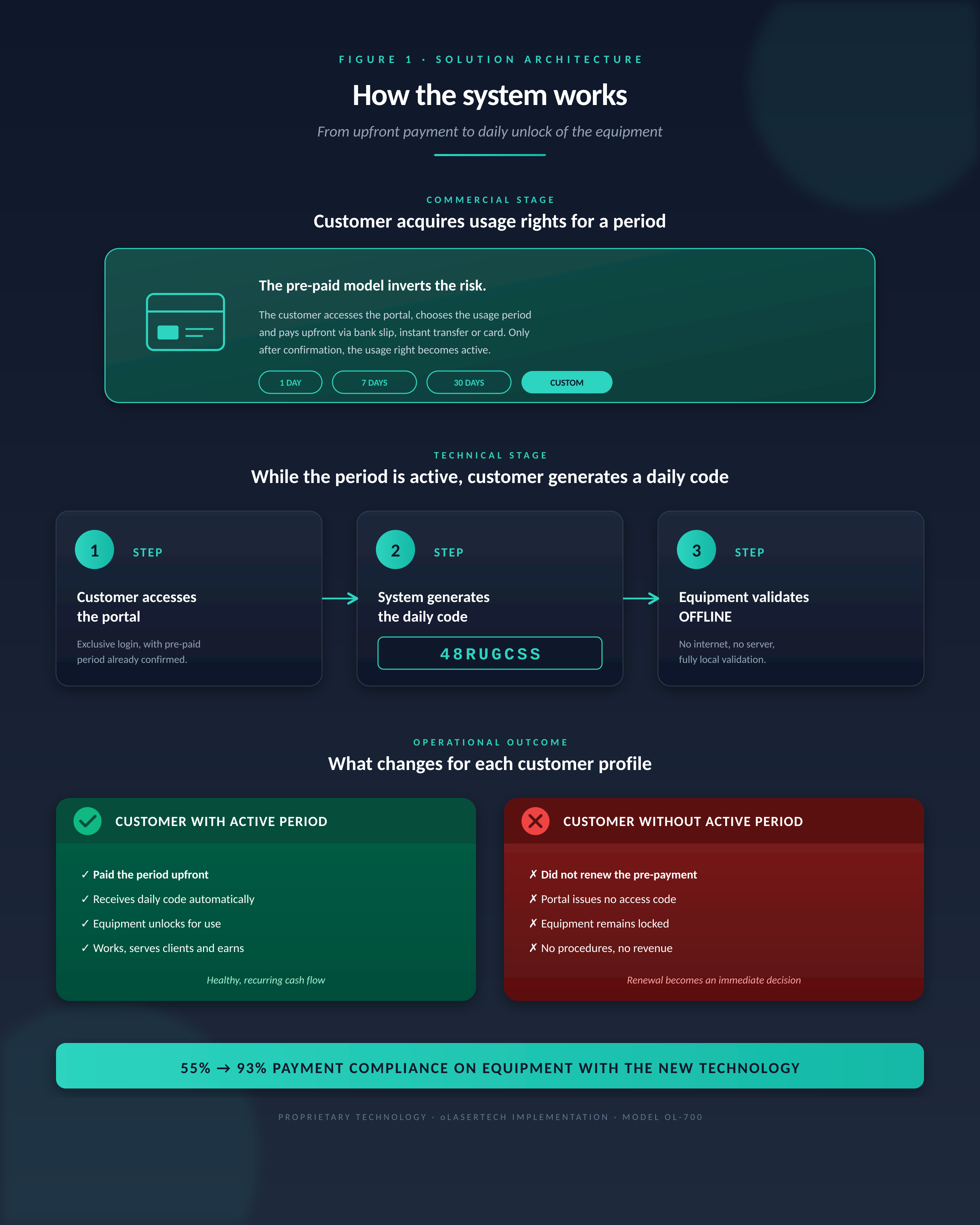
This mechanic completely transforms the commercial relationship. Payment ceases to be a future promise subject to collection efforts and becomes an immediate condition of operation. There is no longer the classic notion of a "late customer" — the customer is either paid up and operating, or halted and generating no revenue. And because the customer's revenue depends entirely on the machine working, the incentive to keep payments current becomes insurmountable.
It is also worth noting that the system provides an operating mode for customers who choose full upfront payment: in that case, a fixed master code, also cryptographically protected and bound to the equipment's serial number, is issued once and grants permanent access to the equipment — without dependency on the portal. The technology is thus flexible enough to serve both the market that needs installment plans and the market that wants full autonomy.
4. The results: from 55% to 93% payment compliance
The technology began deployment on the oLaserTech OL-700 equipment line in the last quarter of 2025. Before it, the company operated with a mixed model of cash sales and traditional installment financing, facing exactly the problems described above: an average payment compliance rate of 55%, long collection cycles, high administrative cost with renegotiations, and a significant percentage of actual losses.
After the deployment of the cryptographic unlock system, the scenario changed structurally. The equipment base under the new technology reached, in its first six months of operation, a compliance rate of 93% — a 38-percentage-point jump over the previous model. More relevant than the absolute number, however, is the nature of that change: the 7% that still appear as "unpaid" in a given month are not delinquency in the classic sense, but rather customers who have simply suspended use temporarily for operational reasons (vacation, clinic renovation, seasonality) and will resume payment when they return to operating.
From a treasury standpoint, the effect is even clearer. The average receivables cycle dropped dramatically, collection costs were practically eliminated, and cash-flow predictability increased dramatically. oLaserTech shifted from a transactional commercial model to effectively operating as a subscription company, with predictable recurring revenue and structural retention — characteristics typically associated with mature technology companies.
But the result I find most significant is not directly in the treasury. It is in the profile of the new customers who gained access to the equipment. In the six months following deployment, oLaserTech enabled commercial operations for dozens of professionals who, under the previous model, would have been rejected for credit reasons. Dental surgeons early in their careers. Estheticians building their own businesses after years as employees. Professionals in small cities where no traditional financing company would operate. That, at the end of the day, is the social impact the technology enables: qualified professionals regain access to the means of production they need to work.
Technical and operational summary of the solution deployed on oLaserTech OL-700 equipment.
5. Why this matters for Brazil
The technology I described is, technically, a refinement of cryptographic mechanisms already established in the scientific literature for decades. I am not claiming a mathematical invention here, and the underlying algorithm is public. What is new, and what I consider relevant from a national-impact standpoint, is the application: using this cryptographic architecture to solve a specific structural problem of the Brazilian medical equipment market, creating a business model that did not exist before and that opens access to a market that was previously blocked.
The potential for replication is enormous. I'm not talking only about laser hair-removal equipment. I'm talking about any durable good of medium to high unit value that requires recurring operation and is a target for installment sales or rental: radiofrequency equipment, focused ultrasound, dental surgical laser, imaging diagnostic equipment for smaller clinics, advanced physiotherapy equipment, and so on. Each of these markets faces the same commercial barrier, and the same technological architecture can be applied.
From a macroeconomic standpoint, technologies that reduce friction in access to productive credit have a multiplier effect. When an esthetician can open her own business because she did not need a guarantor, she generates income, hires employees, pays taxes, and moves the local economy. When a Brazilian manufacturer can sell more equipment because of this mechanism, it invests more in research, hires more engineers, generates more patents, and reduces dependency on imports. It is the kind of technology that has small impact individually but large impact in aggregate — and that only makes sense in economies like Brazil's, where credit friction is the great limitation.
It is also important to highlight the aspect of technological sovereignty. The solution was fully developed in Brazil, with Brazilian engineers, to attack a problem that is characteristically Brazilian. The cryptographic algorithm is an open international standard, but the application architecture, the commercial model around it, and the integration with the manufacturer's hardware are intellectual property developed here. In a context where the country frequently imports off-the-shelf technological solutions from markets that do not understand our reality, creating local technology for local problems is a value in itself.
6. What comes next
The technology continues to evolve. Together with the oLaserTech team, we are working on three expansion fronts that should enter production during 2026.
The first is portability of the solution to other oLaserTech equipment lines beyond the OL-700 model — with minimal firmware adaptations, the company's next devices will already leave the factory with the system embedded, with no need for retrofit. The second is licensing to other Brazilian manufacturers of medical and aesthetic equipment facing analogous commercial problems. Initial conversations along these lines have already begun, and market interest has been significant, particularly among mid-sized manufacturers that lack the internal capacity to develop something equivalent. The third is the evolution of the subscription model itself, incorporating new flexible periods (hourly use, per-procedure use, hybrid plans) that are only economically viable when the access-control mechanism is as cheap and reliable as this technology provides.
There is also ongoing research work that documents the methodology and results systematically, with the goal of contributing to the Brazilian sectoral literature on commercial models enabled by cryptographic technology. I believe cases like this — where a small Brazilian company uses strong cryptography to solve a concrete commercial problem — deserve to be documented and shared, both to inspire other entrepreneurs and to draw the attention of academics and public policymakers to the power of this type of solution.
"We are not selling cryptography. We are selling access — access to equipment, access to the market, access to a career. The cryptography is just the instrument." — André Roriz
7. Conclusion
The case described in this article has, for me, value that goes beyond the immediate commercial result. It demonstrates that seemingly insoluble economic problems — such as access to credit for small entrepreneurs in a country with the delinquency history that Brazil has — can be creatively reformulated when approached from unconventional technical angles.
Banks, financing companies, and credit agencies have spent decades trying to solve the problem from the risk-assessment side: more sophisticated scoring systems, fiduciary guarantees, insurance coverage. All with limited results. The technology I described solves the problem from a different angle — through technical control of the asset itself — and, in doing so, completely transforms the economics of the commercial model.
This is the kind of contribution I believe in. Technology applied to real problems, with clear impact metrics, replicable, and generating benefit for all links in the chain — customer, manufacturer, and end consumer. It is why I continue to work on solutions like this one, and why I believe Brazil does have the capacity to develop cutting-edge technology for its own problems.
If you are an equipment manufacturer facing similar problems, an entrepreneur thinking about alternative commercial models, or simply someone interested in how technology can be used to solve concrete economic problems, it will be a pleasure to talk. My professional contact is available at the site.